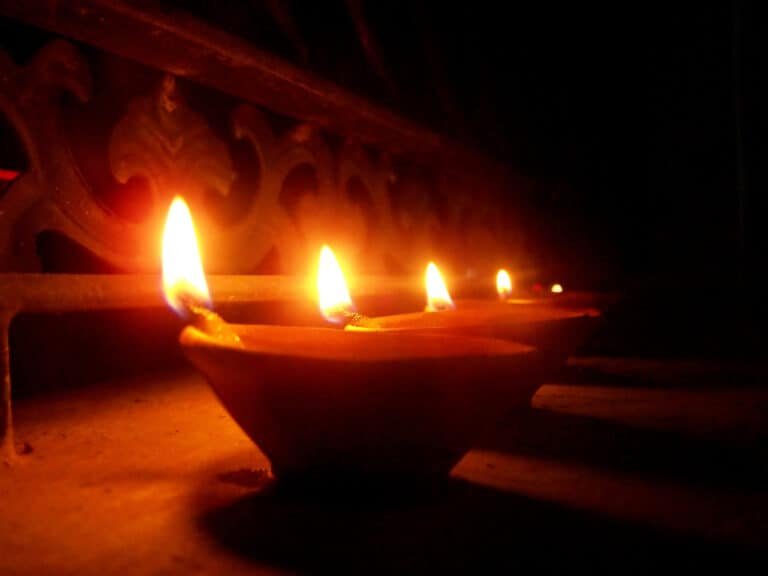
Ma!

The Navaratri of spring is approaching. The 9 nights of Navaratri are sometimes divided into three parts. Three nights for the invocation of Durga, three for the invocation of Lakshmi and three for the invocation of Saraswati. 

Durga is the aspect of the Goddess in its entirety; Mahadevi, who is summoned to fight Mahishasura in the text Devi Mahatmyam. 

Mahishasura is a demon that is half buffalo and half human. One can understand him as our instinctive self.

Among our instincts is one that is very current right now; fear. Fear has a function, to keep us alive. 

The problem with fear as an instinct, however, is that it is meant to function in the face of a direct threat, such as meeting a lion. What it is not programmed for is to be able to determine what is a real threat in connection with complicated facts. 

Only the intellect can help with this. What can the intellect do then? The intellect can look at facts. The intellect can determine which sources are reliable and form an image of a situation based on that. Based on this, the intellect can handle the situation with skill.

Durga is direct and fearless. She enters the battle riding on a lion of courage. She is the very image of courage and strength and readiness. With open eyes she meets what she is facing and fights it, not in panic, but with skill. 

Sometimes, however, self-assessment of risks and skills in handling the situation is not enough. Somewhere we realize that we can not avoid all risk. That we can not completely control anything.

In the tantric text Devi Mahatmyam, the gods turn to Mahadevi (the Great Goddess) when the world threatens to perish, and despite all their own attempts, they have not been able to stop it. 

Ma! Ma! Ropar de. And hope for the protection of the great mother. 
Music: Invocation, Playlist. 


Similar Posts

  • Yoga as a truth-seeking

    Tantra speaks of the actions of “the All”, which are also the individual’s 5 powers. These are: Srsti-creation Stihiti-stasis Samhara-dissolving Tirodhana-forgetting, veiling Anugraha-unveiling, remembrance These actions are the acts of consciousness. Consciousness can create a thought, hold on to a thought, let a thought dissolve, and can forget something by dropping the focus on it….

  • To bear his pain

    The new moon 23/2 falls in the area of the sky called Shatabhisha nakshatra. Shatabisha means 100 healers. It is a time that benefits healing from illness or trauma. Mercury has a strong influence this time as well, making old pain prone to coming to the surface.  The tantric exercises aimed to release energy that…

  • To be worthy

    A legend from the 12th-14th century described in the text Matsyendra Samhita describes how the fisherman Mena is swallowed by a whale. The story tells how Mena is devoured by a choice and thereby hears secret teaching from Shiva when, at Shakti’s request, he teaches her the ultimate being of everything, at the bottom of…

  • To hit the target

    In the Amshu Tantra (1000s) and further through Tattwa Chintamani (in 1577) positions are given that are reminiscent of a straight stick, a stick broken into several parts in shape, or arcuate shapes. These are called dandas (sticks) and are also the names used for the positions in the sun salutation. One of the positions…

  • Sri Yantra

    What happens when contraction and expansion take place at the same time? Perhaps it is these circumstances that can create something truly new. A contraction to a nothing/ a small still point of concentrated energy, and then an explosion into a new creation. The Tantric tradition speaks of prakasha and vimarsha. Prakasha is the unmanifest…

  • Being with truth

    One student asked me after the last post, this appropriate question: So if you want to go through the process of Yoga, of facing truth more and more, how do you do it? Last time, we talked about Yoga as a truth-seeking tradition, and about unveiling layers of untruth and faulty knowledge. We also talked…