Trust-Vasanta Navaratri
25 / 3-3 / 4 is Vasanta (spring) Navaratri. The 9 nights when you celebrate the Goddess, also called Shakti and Kundalini.
The goddess is the energy aspect of consciousness. In its entirety, she is the energy behind everything that exists. She is then called Mahadevi or Maha Durga. In this form she is also seen as a mother.
In the last entry, the text Devi Mahatmyam was mentioned, which is a text recited during Navaratri. It tells the story of how Mahadevi saves the world from dark, demonic forces (Asuras). Devi Mahatmya is a tantric text and needs to be read and understood accordingly, as a symbolic text.
The text begins with Shumba and Nishumba two Asura brothers gathering an army of warriors with supernatural powers to take over the world. These powers have been given to them by the creator god Brahma as a reward for their yogic efforts. According to the law of karma (cause and effect), no effort can be unrewarded regardless of what the intention behind it looks like.
The brothers wish they could not be defeated by any man or god, and so it is.
But there is a gap. A wise yogi sees this and contacts Indra (the master intellect of the elemental gods) and points out the door. He points out that nowhere are women mentioned.
He says: – Go to Durga / Mahadevi. Ask her to intervene in the world. She’s waiting for you to ask.
The goddess can be seen as the power of grace. We must acknowledge our helplessness and ask for help.
For 20,000 years (sometimes it feels like it takes too long before help comes) they pray. Then the Goddess appears.
When the Goddess confronts Shumba and Nishumba, they are first struck by her beauty and want to let her be a part of their harem. The goddess then says that she made a promise that she can only marry someone who can defeat her in battle. Shumba and Nishumba then give their subordinate orders to pull her hair.
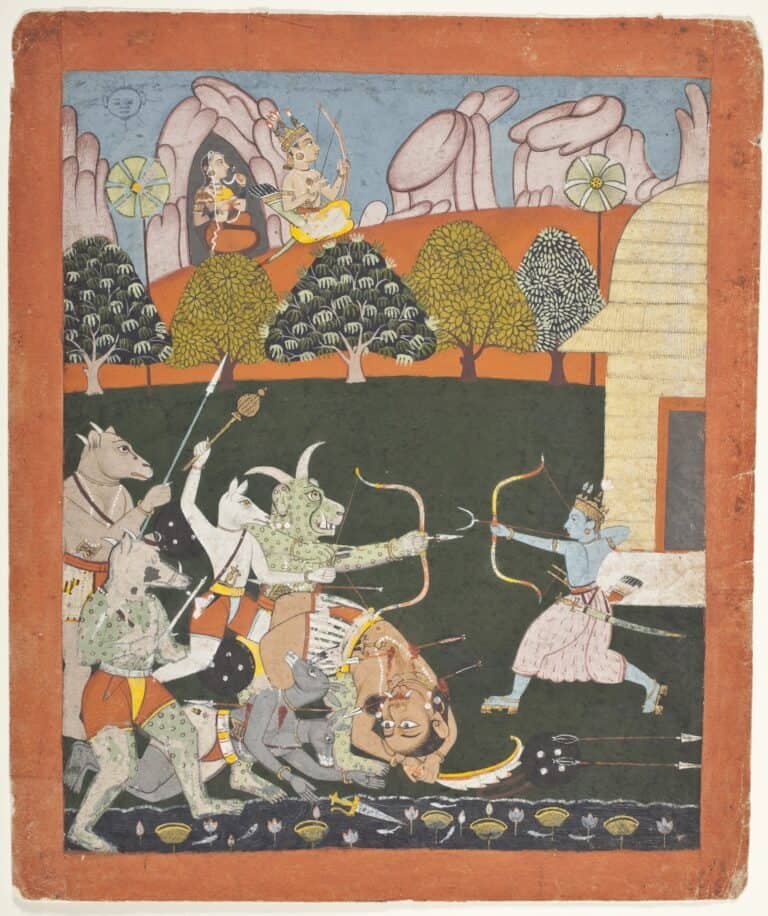
The goddess fights Shumba and Nishumba’s armies and defeats them. The armies consist of creatures that are half human and half animal. The highest of them is Mahishasura who is a demon who is half human and half bull. One can understand Mahishasura as a personification of the quality known as tamas. Tamas is a quality of stability, but in too much it means inertia, unwillingness to develop or change, comfort and passivity. In this track, manipulative behavior and self-deception often appear.
During this struggle, as a personification of the wrath of the Goddess, Kali emerges from her third eye.
Durga is then confronted by the demon general Raktabija, whose name means drop of blood. His power lies in the fact that for every drop of blood he spills, a new clone emerges.
Raktabija can be understood as the personification of quality rajas.
Rajas is desire. To believe that what makes one happy is to satisfy one’s desires, makes them multiply, one becomes a slave under them.
In this battle, six other goddesses emerge from Durga’s body. According to some sources, Indrani, Saraswati, called Vaishnavi, Tara, Chinnamasta, Bhairavi.
Kali overcomes the monster by licking up every drop of blood.
This results in the final battle against Shumba and Nishumba.
When Shumba dies, his last word is Ma (mother), and a smile comes over his face, both demons being transformed and dissolved into the Goddess again. In the end, we all come back to the mother again — our origin and our true identity.
The story wants to show that even though the great mother must eventually set a strong limit to comfort, which goes beyond the collective and excessive desires, her intention is to bring us all back home.
Sources: Awakening Shakti, Sally Kempton. Blogposts, Kavitha Chinnayan.
Music: Vasanta, Playlist.